Why Your Desk Job Is Aging You Faster Than Your Birthday
The quiet damage caused by sitting, poor posture, low steps, stress breathing, and weak daily movement
Your birthday is not the real problem.
Your chair is.
Most men over 40 blame age for the stiff hips, tight back, low energy, belly fat, poor posture, weak glutes, shallow breathing, and that “older than I should feel” heaviness that follows them through the day. They talk like the calendar suddenly betrayed them, as if turning 42, 47, or 53 automatically means feeling slow, sore, and half-alive.
That is not the full truth.
Your desk job may be aging you faster than your birthday because it trains your body to become weak in exactly the ways a man over 40 cannot afford. Sitting for hours shuts down daily movement. Poor posture teaches your body to fold forward. Low steps make fat loss harder. Stress breathing keeps your nervous system on high alert. Weak daily movement slowly steals the strength, mobility, and energy you need to lead well.
This is not about quitting your job or pretending work does not matter. It is about refusing to let your career turn your body into collateral damage.
The FFIT40 style is direct for a reason: expose the lie, make the cost clear, then give the man a practical path forward. That same no-fluff problem-agitate-solve structure is reflected in the newsletter reference material.
The Problem: You Spend Your Day in a Position Your Body Was Not Built to Live In
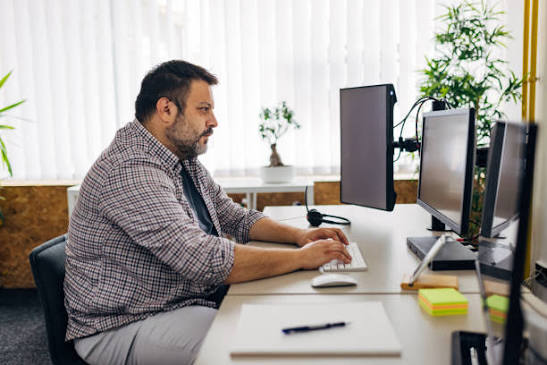
A desk job can look productive from the outside while quietly wrecking your body from the inside. You sit through calls, hunch over a laptop, round your shoulders, tighten your hips, breathe shallowly, and maybe walk a few thousand steps if the day is “busy.” Then you get home exhausted, stiff, and mentally cooked, even though you barely moved.
That is the trap.
You are not physically tired because you worked your body hard. You are drained because you kept your body locked down while your stress stayed high. That combination is brutal for men over 40.
The World Health Organization’s physical activity and sedentary behavior guidelines emphasize that adults should limit sedentary time and replace it with physical activity of any intensity, because more sedentary time is associated with poorer health outcomes. The American Heart Association has also warned that prolonged sitting is linked with higher risks for heart disease, stroke, and poorer mental health, even among people who exercise.
Read that again carefully.
Even among people who exercise.
That means a few workouts per week do not give you permission to sit like a statue for the rest of your life. Your body cares about the whole day, not just the one hour you decide to “get serious.”
The Hard Truth: Your Desk Is Training You
Every day, your desk job teaches your body a lesson.
It teaches your hip flexors to stay short. It teaches your glutes to stay quiet. It teaches your shoulders to round forward. It teaches your neck to reach toward the screen. It teaches your breathing to stay shallow. It teaches your metabolism to operate at a lower daily output.
Then you stand up and wonder why you feel old.
You are not just sitting. You are adapting to sitting.
That is the part most men miss. The body adapts to whatever you repeatedly ask it to do. If you spend most of the day folded, compressed, stressed, and under-moving, your body will become better at being folded, compressed, stressed, and under-moving.
That is not aging.
That is training in the wrong direction.
Sitting: The Silent Fatigue Multiplier
Sitting feels harmless because it does not create immediate pain for most men. That makes it dangerous. The damage shows up slowly through a weaker posterior chain, tighter hips, lower daily calorie burn, worse circulation, more stiffness, and a body that feels heavy even before the day begins.
The issue is not that sitting is evil. The issue is that prolonged, uninterrupted sitting becomes the default position for the modern man. You sit for work, sit to commute, sit to eat, sit to relax, then lie down and wonder why your body feels like it is losing its edge.
This is why daily movement matters. Not dramatic movement. Not complicated movement. Consistent movement.
A man who trains hard for 45 minutes but sits for 10 hours and barely walks is still living in a mostly sedentary body. That matters for fat loss, blood sugar control, joint health, energy, and long-term performance.
Your first standard is simple: break the sitting pattern. Stand up at least once every hour. Walk during calls when possible. Use stairs. Park farther away. Take a 10-minute walk after meals. Do not let your workday become one long seated block with a few bathroom breaks pretending to be movement.
Poor Posture: The Body Language of Decline
Posture is not just how you look.
It is how your body distributes stress.
When your head drifts forward, shoulders round, chest collapses, and hips stay flexed all day, your body starts paying interest. Neck tension, shoulder tightness, lower back discomfort, shallow breathing, poor training mechanics, and fatigue can all be tied back to the positions you repeat.
A scoping review on office workers noted that prolonged static sitting and awkward postures contribute to musculoskeletal pain and discomfort, especially in desk-based work.
Most men try to solve this with a better chair, a new desk setup, or another gadget. Those may help, but they do not fix the deeper issue. The real issue is that your body needs movement, strength, and mobility, not just a more expensive way to sit still.
Your posture reset does not need to be complicated. Open the chest. Strengthen the upper back. Stretch the hip flexors. Train your core to support your spine. Keep the screen at eye level when possible. Stop working from a couch like a teenager with a laptop and no standards.
You do not need perfect posture every second. You need fewer hours of collapsed posture and more daily reminders that your body was built to stand tall.
Low Steps: The Fat-Loss Killer Nobody Wants to Admit
A lot of men over 40 are not stuck because their workout is wrong. They are stuck because their daily output is pathetic.
That sounds harsh because it needs to.
You can eat “pretty well,” work out a few times a week, and still gain belly fat if the rest of your day is almost motionless. Low steps reduce daily energy expenditure, and when that combines with stress, poor sleep, grazing, and lower muscle mass, the waistline starts moving in the wrong direction.
Steps are not glamorous, which is why men ignore them. But ignoring the basics is exactly how men end up overcomplicating problems that should have been solved with standards.
The target is 10,000 steps daily. Not because it is magical, but because it forces you to stop living like your body is only needed when the calendar says “workout.” Walk before work, after meals, during calls, between meetings, or after dinner with your family. A man who says he has no time to walk usually has plenty of time to scroll, sit, snack, and complain that his metabolism slowed down.
Walking is not beneath you.
It may be the missing baseline.
Stress Breathing: The Hidden Signal That Keeps You Wired
Desk jobs do not just create physical stiffness. They also train a stress pattern.
You sit, stare at screens, manage pressure, respond to messages, handle conflict, chase deadlines, and breathe from your chest all day without noticing it. Shallow breathing keeps the body in a guarded state. Your shoulders rise. Your jaw tightens. Your neck stiffens. Your nervous system stays on alert.
That is not leadership.
That is low-grade survival mode.
Diaphragmatic breathing has been studied as a way to support stress regulation, with research showing potential benefits for attention, mood, and cortisol levels. This does not mean breathing fixes everything. It means your breathing is a lever, and most men are ignoring it.
Use it.
Take 3-5 minutes during the workday to breathe slowly through the nose, expand the ribs and belly, and lengthen the exhale. Do it before a difficult call, after a stressful meeting, before eating, or when you catch yourself reaching for food because the day is running you instead of the other way around.
You do not need to make breathing spiritual or strange. You need to use it like a grown man uses a tool.
Weak Daily Movement: The Real Reason You Feel Older Than You Are
Most men think “fitness” means workouts.
That is incomplete.
Workouts matter, but daily movement is the foundation. Your body needs frequent signals that it is still required. If the only movement you give it is a few scheduled sessions each week, then spend the rest of the time sitting, slouching, and breathing poorly, your body gets mixed messages.
Strong for an hour.
Sedentary for the rest of the day.
That is not a solid strategy.
Weak daily movement shows up everywhere. It shows up when stairs make you breathe harder than they should. It shows up when your hips feel locked after a car ride. It shows up when your back complains after standing for 20 minutes. It shows up when you avoid physical tasks around the house because your body feels older than your responsibilities.
The solution is to build movement into the day so your body never goes completely dormant.
Stand between meetings. Walk after meals. Stretch your hips and chest daily. Do short mobility resets. Add loaded carries when appropriate. Use a weighted vest walk if it fits your ability and environment. Keep water nearby and drink consistently. Aim for 7-8 hours of sleep so you are not trying to fix exhaustion with caffeine and snacks.
This is not about doing more random work.
It is about creating a body that stays awake all day.
The FFIT40 Desk Job Reset
If your job requires a desk, fine. That does not mean your body has to become desk-shaped.
Start with the first 10 minutes of the morning. Before the inbox takes ownership of your nervous system, move. Walk, stretch, breathe, and get water in. You do not need a perfect routine. You need to stop starting the day in a chair with a phone in your face.
During the workday, break sitting every hour. Stand up, walk for a few minutes, open the hips, pull the shoulders back, and breathe deeply. Do not wait until pain forces you to move. Move before your body has to complain.
Set a step target and treat it like a business metric. If you would not ignore your revenue numbers, do not ignore your steps. Ten thousand steps per day gives you a clear standard and removes the guesswork.
Use food discipline to avoid the desk-job belly trap. Sitting all day and eating high simple carbs is a bad combination for men over 40. Keep meals protein-focused, keep simple carbs low, use complex carbs within reason, stay hydrated with 4L of water, and avoid grazing through the workday like stress is a valid meal plan.
End the day with a reset instead of collapsing. Take a walk after dinner. Stretch your hips, back, shoulders, and calves. Breathe slowly. Get off screens before bed. Protect 7-8 hours of sleep as often as possible because recovery is not weakness. It is maintenance for men who still have people depending on them.
The Bigger Picture
Your desk job may fund your life, but it should not quietly steal your strength.
You are not building a better future for your family if you are sacrificing the body required to enjoy it. You are not serving your partner well if you come home stiff, irritable, exhausted, and unavailable. You are not setting the right example for your kids if they only see a man who works hard but lets his health decline by neglect.
This is about more than posture and steps.
It is about stewardship.
Your body is part of your leadership. The way you move, breathe, eat, recover, and carry yourself tells the people around you what kind of standard you live by. You do not need to be perfect, but you do need to stop pretending that sitting all day has no consequences.
Your birthday is not aging you as fast as your daily habits are.
Fix the habits.
Closing Impact Statement
Your desk job is not an excuse to become stiff, soft, tired, and disconnected from your body. Sitting, poor posture, low steps, shallow breathing, and weak daily movement are not minor issues after 40. They are daily signals that tell your body to decline.
Stand more. Walk more. Breathe better.
Stretch daily. Train consistently. Drink the water. Protect your sleep.
Lead your body before your chair does it for you.